



Reviewed by Access Control Solutions Lead at MIT, drawing on the company’s experience specifying and installing biometric and access-control systems for Abu Dhabi businesses since 2005. Last updated August 2026.
A punch card gets lost. A swipe card gets shared with a colleague running late. A signature on a paper register gets filled in after the fact by someone who was never actually there. If any of this sounds familiar, you are not alone – most businesses in Abu Dhabi that still run on manual or card-based attendance eventually hit the same wall: the numbers on paper stop matching what is happening on the floor.
That gap is why so many businesses across Abu Dhabi and the wider UAE are exploring biometric access control in Abu Dhabi, UAE. It isn’t about chasing new technology – it’s a practical response to buddy punching, payroll disputes, unauthorized entry, and growing expectations around accurate workforce and security records.
This guide compares biometric and traditional attendance systems honestly, including cost factors, so you can decide what actually fits your business.
Biometric Access Control vs Biometric Attendance: What's the Difference?
The two terms get used interchangeably, but they solve different problems:
- Biometric access control verifies identity to permit or restrict physical entry – who can open which door, floor, or zone.
- Biometric attendance verifies identity to log working hours for payroll and HR.
Many businesses in Abu Dhabi now combine both into one platform, so a single fingerprint or face scan can unlock a door and record attendance at the same time – giving you who entered, when, where, and whether they were authorized, in one record. That combination is what most growing businesses eventually adopt, since it avoids running two separate systems.
Where Traditional Attendance Systems Fall Short
Traditional attendance covers manual registers, punch cards, and swipe or RFID card systems. Each has worked for decades, but the weaknesses tend to surface as a business grows.
Buddy punching is built into the system.
A card or signature only proves a card or pen was used – not who used it. This is a commonly cited source of payroll leakage across shift-based and multi-site businesses.
Cards get lost, cloned, or shared.
Every misplaced card is a security gap until it’s deactivated.
Manual reconciliation eats HR time.
Someone has to cross-check registers against payroll every cycle, which adds up across dozens or hundreds of employees.
Audit trails are weak.
In a dispute – a missed shift, an access complaint, an insurance claim – a paper register or basic card log rarely provides the clean, timestamped evidence needed.
For very small teams with high trust, this may still be workable. For most growing Abu Dhabi businesses, the risk has quietly outgrown the convenience.
What a Biometric System Actually Changes
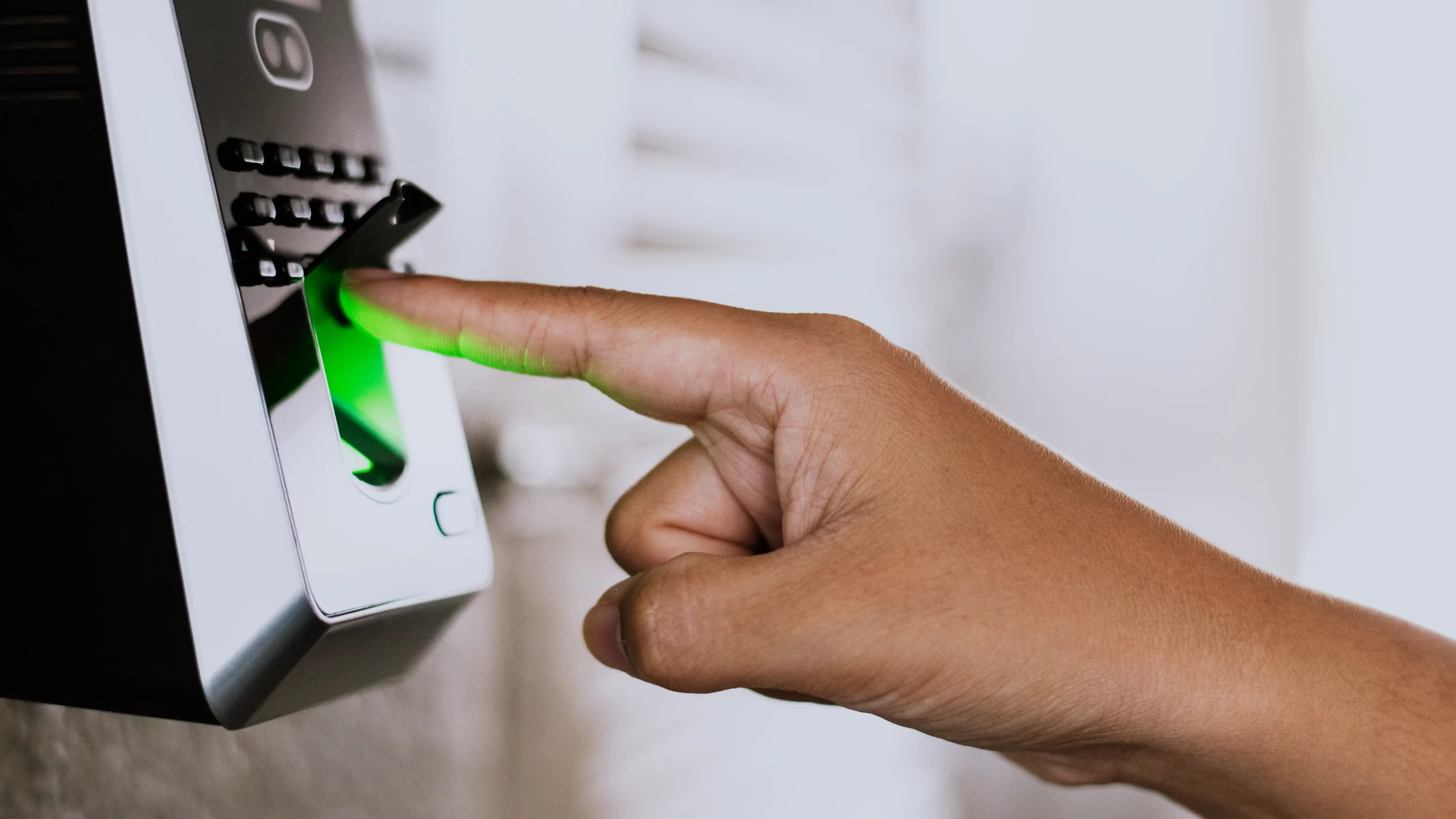
A biometric access control system for UAE businesses uses something that can’t easily be borrowed or shared – a fingerprint, face, or both together in higher-security setups.
- Identity is confirmed, not assumed – no more “who used this card” ambiguity.
- Attendance and access work together in one platform, tied to each employee’s role.
- Data can flow into payroll, cutting manual entry where the system is integrated with your existing software.
- Records tend to hold up better under scrutiny, offering a stronger audit trail for compliance checks or investigations than a signed register.
- Fingerprint and face recognition attendance systems in the UAE have improved on dusty sites or with gloves and masks, though performance still varies by device quality and environment – worth testing before a full rollout.
What Determines Biometric Access Control Cost in Abu Dhabi?
Pricing isn’t one-size-fits-all. The main factors that shape a quote include:
- Number of employees and enrolment volume
- Number of doors, zones, and devices required
- Fingerprint, face recognition, or dual-mode hardware
- Attendance and access-control software licensing
- Integration with existing payroll or HR systems
- Installation, cabling, and networking
- Ongoing maintenance and multi-site support
Because these vary so much site to site, the most reliable way to get an accurate figure is a short site review rather than a generic price list.
FAQ
Is biometric data safe under UAE regulations?
Many modern systems store encrypted biometric templates rather than raw images, but storage and processing practices vary by vendor. Note: data-handling requirements can differ depending on how information is collected, stored, transferred, and retained – confirm your specific obligations and the vendor’s practices before deployment.
Is biometric attendance mandatory in the UAE?
Not universally required for every business. Whether a particular attendance method is appropriate depends on your workforce, sector-specific regulations, and internal policy – this is worth confirming with your compliance advisor rather than assuming from general guidance.
Fingerprint or face recognition – which is better?
Fingerprint tends to suit fixed workstations and offices; face recognition suits high-traffic or contactless entry points. Many Abu Dhabi sites use both.
Can it integrate with payroll software?
Many current platforms support integration with common payroll and HR systems, though this should be confirmed against your specific software before purchase.
How long does installation take?
A single-site rollout can often be completed within days for straightforward setups, but timelines depend on site size, number of access points, staff enrolment, and integration requirements.
Biometric vs Traditional Attendance: Side-by-Side
Factor | Traditional (Register/Card) | Biometric System |
Buddy punching risk | High | Very low |
Identity verification | Weak | Strong |
Payroll integration | Usually manual | Often automated |
Access control | Separate system needed | Can be built in |
Audit trail | Limited | Detailed |
Scalability across sites | Limited | High |
Still relying on cards, registers, or a standalone attendance machine? MIT can review your current setup and recommend a system matched to your workforce size and entry points.
Before You Buy: Questions to Ask a Vendor
- Does it integrate with our existing payroll or HR software?
- How many employees and doors can it support?
- What happens to access if the network goes down – can it operate offline?
- Where and how is biometric data stored and encrypted?
- What’s the process when an employee leaves the company?
- What happens if a device fails – is there a backup entry method?
- What installation and ongoing maintenance support is included?
A rushed, one-size-fits-all installation – not the technology itself – is usually why some businesses end up disappointed with biometric systems.
Built for Abu Dhabi's Working Environments
Different sites need different things from an access control and attendance system in Abu Dhabi:
- Construction: contractor and shift attendance paired with restricted site access
- Healthcare: staff-only zones and shift-based scheduling
- Warehousing: workforce entry tracking and restricted storage areas
- Hotels: employee-only back-of-house access
- Corporate offices: employee authentication and floor-level permissions
Biometric security systems are increasingly paired with CCTV and network security as one connected setup, giving businesses both workforce accountability and physical security under a single system.
Conclusion
Attendance and access to data quietly shapes some of a business’s biggest decisions – who gets paid for what, who can enter where, and what your records show when something goes wrong. A system that can’t verify identity accurately becomes a costlier risk with every employee added.
MIT has supplied and installed biometric and access-control solutions for Abu Dhabi businesses since 2005, working with ZKTeco, Matrix, ESSL, and BIOMAX to match hardware to each site. Businesses looking to connect attendance with payroll can also explore MIT’s business management software solutions.